Quture - AI Fashion Marketplace for Gen Z
GenZ's all-in-one AI fashion marketplace where style finds you.
A viral thrifting app for Gen Z fashion enthusiasts, 10k users, $300k GMV, $50k+ raised.
TLDR I built Quture to make secondhand fashion joyful again. Over 18 months we reached 30K downloads, 10K monthly active users, and 300K GMV while learning hard lessons about product judgment, execution speed, team standards, and fraud resilience.
This case study presents the WHY, Methodology, and Evidence behind the work.
It reads like proof, showcasing my passion, determination, and lessons learned as we work as a team to help GenZs find their true aesthetic identity.
Think Pinterest where every pin is instantly purchasable from real closets.
9 MVPs shipped
5 college campuses reached
30K total downloads
10K monthly active users
300K GMV in 18 months
Role
Product Manager UX/CX Lead Go-To-Market Full-stack developer
Timeline
2024 ~ 2025
Skills
Figma Xcode Notion Jira Airtable Framer
Overview
————————————————————————————————————————————————————————————————————————————————————————————————————
Problem
Secondhand fashion online is messy. It’s hard to discover your style, trust sellers, or enjoy the process.
Solution
Quture turns secondhand shopping into a curated, social, and personalized experience, imagine buying straight from your pinterest fashion moodboard.
Mission
GenZ's all-in-one AI fashion marketplace where style finds you.
Why build a fashion marketplace?
————————————————————————————————————————————————————————————————————————————————————————————————————
Since high school,
I’ve been obsessed with curating my daily outfits.
Not just to look good, but because fashion is how I express who I am. It’s my personal philosophy, made wearable.
Over the years,
I tried everything to document my style evolution and connect with others who shared the same obsession. I tested apps. Joined fashion forums. Searched for communities where people actually exchanged clothes and inspiration. Nothing clicked.
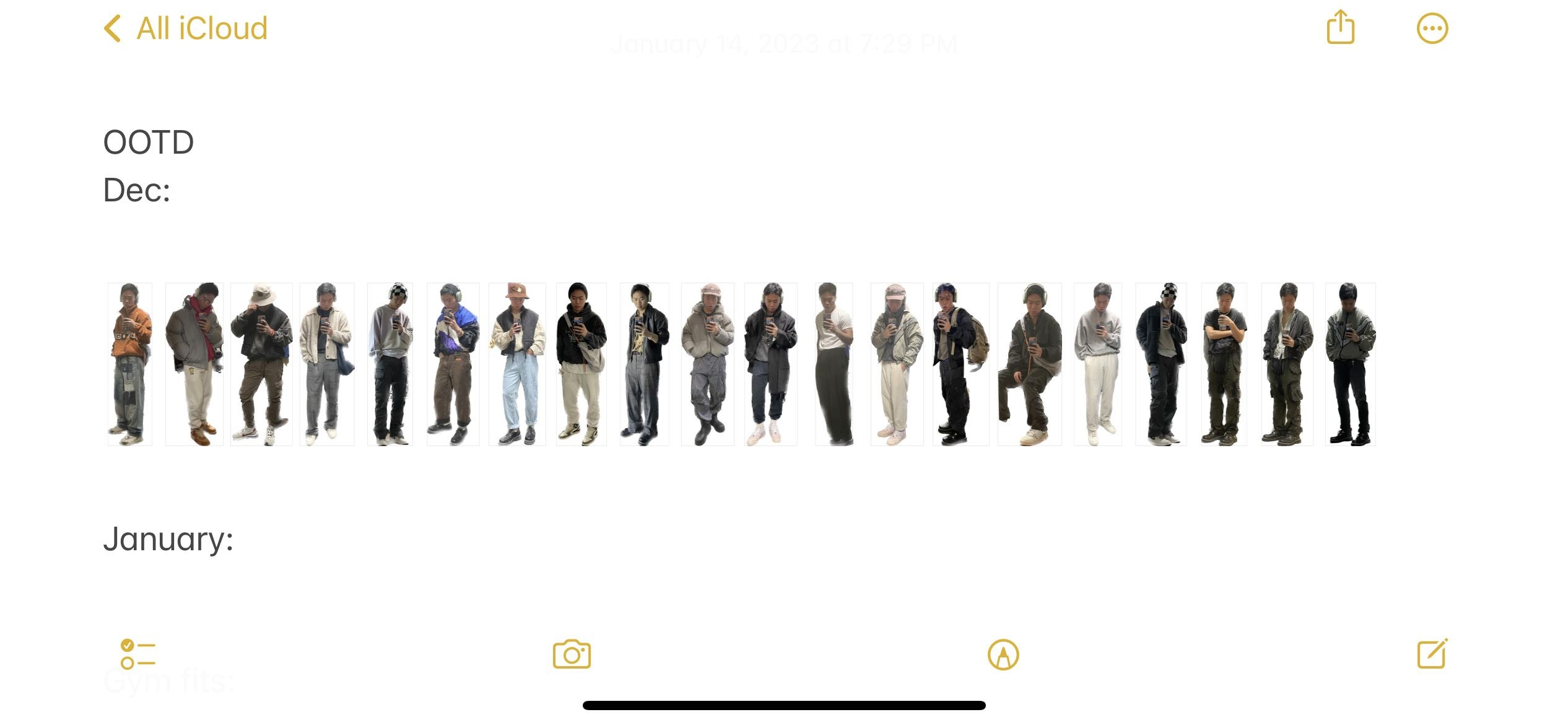
Eventually, I resorted to the most manual process imaginable: snapping photos of my outfits and saving them in my Notes app. That was my style archive. (As shown below)
But,
When it came to finding new pieces, the experience was equally frustrating. I’d scroll endlessly through clothing sites, only to find nothing that matched my taste or my budget. Either it was the wrong vibe, or way too expensive.
I realized something bigger was broken.
There was no smooth way to explore fashion online. No serendipity. No sense of discovery. Everything was engineered to push a purchase, not nurture self-expression. And as someone deeply passionate about fashion, I felt disconnected, from the joy of sharing my style, from finding others like me, from any real fashion community that got it.
Meanwhile, the fashion industry is worth over $1.84 trillion,
Yet it's wildly fragmented and outdated in how it connects creators, curators, and consumers.
Gen Z isn’t looking for polished ads or soulless storefronts. We value authenticity. We follow each other’s style. We trust what our friends, peers, and favorite creators wear. That’s where inspiration—and influence—really happens.
So I started thinking:
What if there was a Pinterest you could actually shop from?
A space where outfit inspiration could flow straight into a secondhand marketplace.
Where discovery felt natural, and curation had value.
That’s when the idea for Quture was born.
Our Northstar & Scope
————————————————————————————————————————————————————————————————————————————————————————————————————
China vs US, Sitting at A Crossroad
To decide where to launch first, we spoke with over 100 shoppers and thrift store owners across China and the U.S.
China has its own thriving online fashion culture,
Red Note being a standout example and a big influence on our product’s UI/UX. But despite the creative energy, secondhand still carries social stigma there. More importantly, China lacks the trust rails, verification, payment protection, and reliable logistics—that secondhand commerce needs to thrive.
The U.S. tells a very different story.
Here, Gen Z embraces secondhand as a mix of identity and value. The infrastructure is solid. The culture is ready. Trust is expected, and supported. That made our decision clear: build in North America first, revisit China when cultural norms and tech rails catch up.
Two platforms helped shape our vision:
Red Note (China) and Pinterest (U.S.).
As a power user of both, I saw how life-changing it is to visualize and curate your ideal aesthetic—and how empowering it feels to share that with the world.
Now imagine that experience, brought to life inside the most expressive, fast-moving, and community-driven industry of all: fashion.
Where every day is about finding your fit. Your vibe. Your people.
What We’re Building
We’re creating an online fashion marketplace that feels like walking through SoHo on a Saturday—
full of discovery, inspiration, and authentic self-expression.
You’re surrounded by people who get your taste.
You see something. You save it. Make an offer. Or pass in a second.
Trust is built-in: verified sellers, transparent history, secure payouts.
AI does the heavy lifting—style matching, smart fit cues, taste-based ranking, and fraud detection that protects buyers and rewards good sellers fast.
Guardrails
From day one, we’ve focused on depth before breadth.
We’re winning tight campus networks and semi-pro sellers first—before expanding city by city.
We avoid generic feeds. No exposure for unverified sellers. No payment flows that skip risk checks. Every feature must lift one of three things:
activation, trust, or repeat exchange, or it doesn’t ship.
Our North Star
One place where secondhand feels personal, safe, and fast.
Every visit answers three questions, quickly and clearly:
Do I want it?
Does it fit me?
Can I trust the seller?
User Research
————————————————————————————————————————————————————————————————————————————————————————————————————
Understanding how Gen Z discovers and exchanges fashion now
I led and conducted 300+ interviews across WashU, NYU, and Parsons with MVP analytics to separate what people say from what they do.
What we learned from these interviews:
72%
GenZ fashion lovers get inspiration from social media (TikTok & Pinterest), while
1 in 4
GenZ purchase the fashion pieces on these social platforms.
64%
GenZ secondhand shoppers are overwhelmed by the cluttered feed page of exchange platforms, discouraging them to shop for secondhand pieces online.
58%
GenZ shoppers navigate across 3+ platforms, a dozen tabs to to shop for fashion pieces that fit their style.
GenZ shoppers browse in two modes:
Passive background scrolling, quick saves, low intent
Active decision mode, needs fit, vibe, and trust on one screen
How did we approach customer discovery?
Contextual interviews and campus intercepts, short diary studies of buy and sell attempts, PostHog funnels from MVP week for time to first save and offer attempts, JTBD mapping to turn quotes into jobs.
Fashion enthusiasts tell us over and over again
“I love shopping, but after opening 30 tabs, the decision fatigue really kicks in. I wish I could have outfits recommended to me and sold at the same place."
Why this matters?
Lead with taste and trust. Ask for size and style tags only if the payoff is instant. Treat credibility as part of discovery, not a late step.
Demographic
————————————————————————————————————————————————————————————————————————————————————————————————————
Who Are We Building For? (User Empathy + Data-Driven Insights)
Primary Audience:
Age: 18–25 Gender: ~80% Female Generation: Gen Z
Psychographics: Fashion-forward but budget- or sustainability-conscious Inspired by Pinterest, TikTok, Depop, but frustrated by clunky UX and scattered experiences Seeks creative expression through clothing and social validation from community-based engagement
How We Identified This: Conducted 300+ structured interviews, primarily on college campuses (WashU, NYU,Parsons) Ran usage tests during MVP week: 140 downloads, 50+ active hours in 7 days Parsed qualitative sentiment from Reddit (Depop/eBay communities) and Gen Z focus groups Created 5 personas using affinity mapping and JTBD (Jobs To Be Done) frameworks A/B tested early landing page copy + visuals across IG and TikTok, tracked CTR by persona
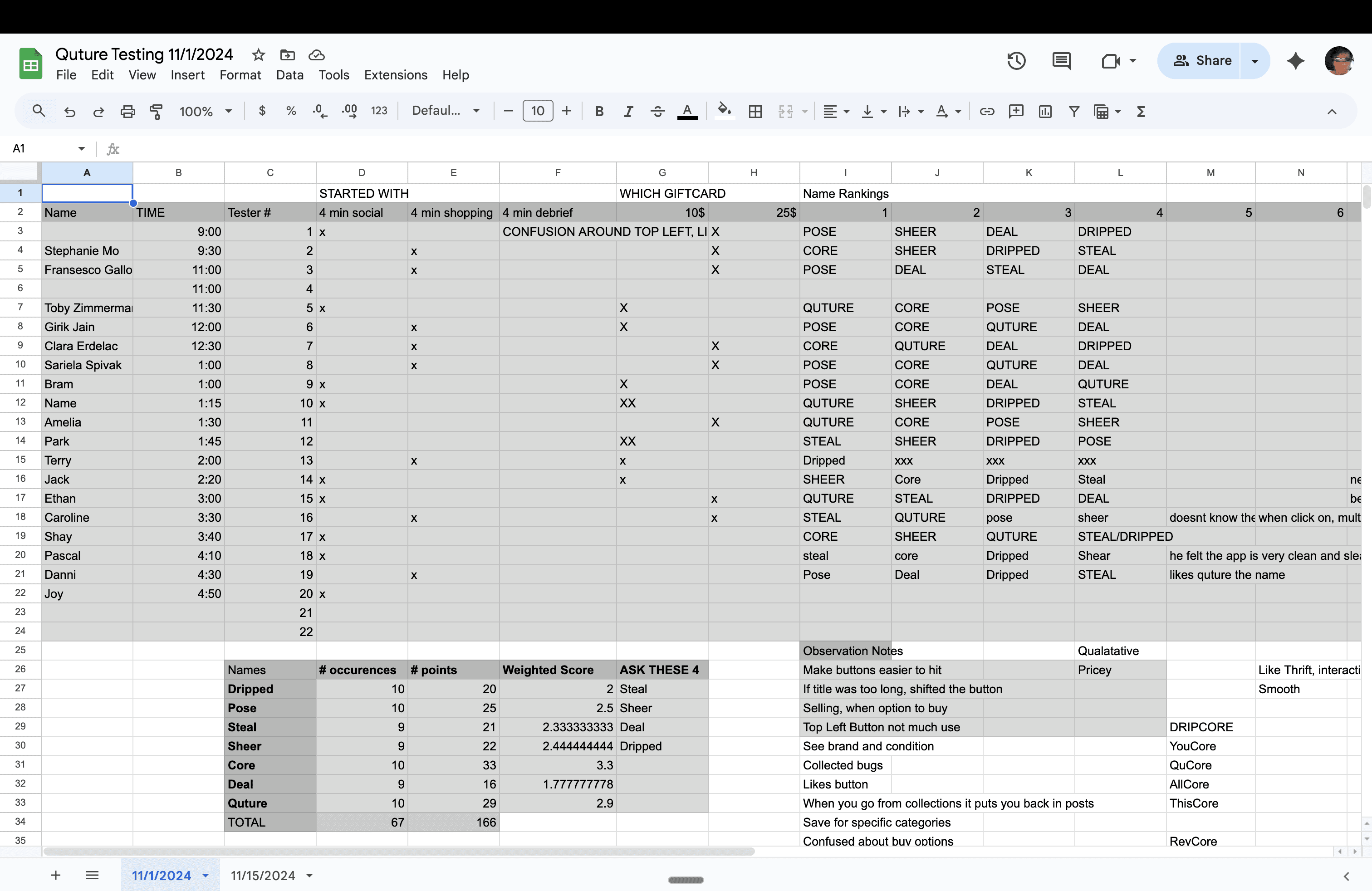
Representative Persona – “Bella R.” 20 y/o college student Scrolls IG + Pinterest nightly Uses Depop but hates lowballers and stale aesthetic Wants clothes with vibe, not just price, thinks “style = self” Trusts referrals more than ads
User Journey & Pain Points
————————————————————————————————————————————————————————————————————————————————————————————————————
USER JOURNEY (Execution + Product Thinking)
1. Awareness & Curiosity (Problem Discovery) Entry Channels: TikTok virality, friend invites, college flyers, outfit-of-the-day reposts Signal: “Why haven’t I heard of this before?” Data Source: UTM-tagged links, invite trees, event-based PostHog tracking
2. Onboarding & Personalization (Activation) Flow: Google Sign-in Upload style genres (from predefined aesthetic clusters) Input height + waist size (used for future styling AI) Goal: Personalization within 30 seconds Insights Used: Heatmaps from MVP v1, recorded sessions via FullStory, rage-click analytics
3. Exploration (Engagement) Modeled after: TikTok + Pinterest hybrid UX Action: Scroll curated fits, save items, follow stylistic users Unique Touch: Moodboard-based browsing over raw product feeds Learnings: Users spent 2.3x longer on moodboards than thrift feed (A/B Group Study, n=60)
4. Exchange (Core Loop) Listing: Sellers upload 3+ styled photos with storytelling captions Buying: No lowballing. Offers are binding, time-limited Trust Layer: Star ratings, visible trade history, group invites Tools Used: Funnel dropoff analysis, exit surveys for ghosting pain points, seller UX diary studies
5. Community & Retention (Delight) Post-sale: AI styles your piece into new looks Gamification: Earn points, badges, invites for being early stylist Network Effect: Each user brings 1.8 others (tracked via viral coefficient during MVP launch) Ongoing Tactics: Referral campaigns with exclusive seller club + leaderboard rankings
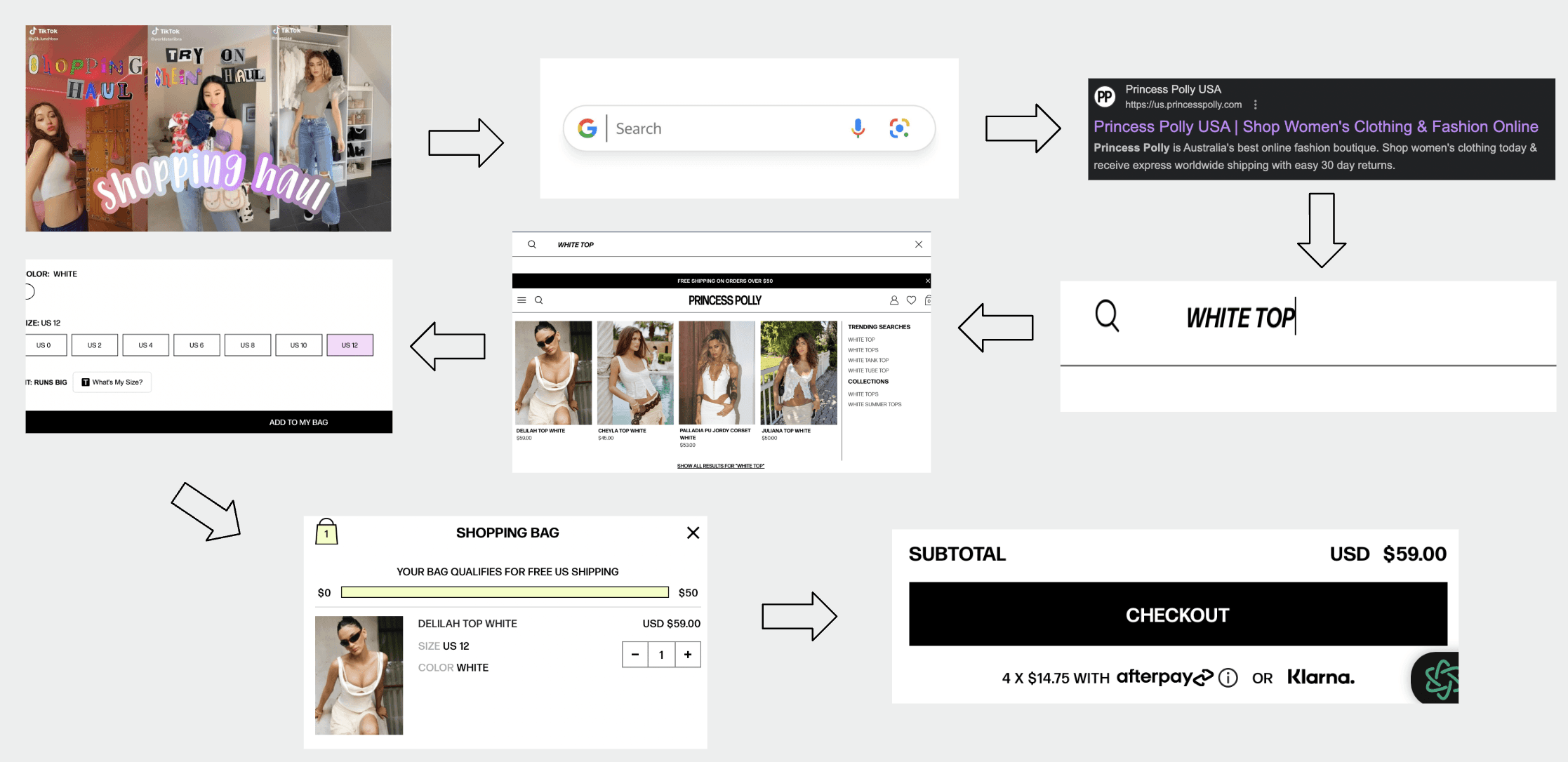
As seen in the user journey above, the average users jump across 3+ platforms, going through a dozen steps to go from, discovery to checking out, often resulting in 90+% cart abandonment.
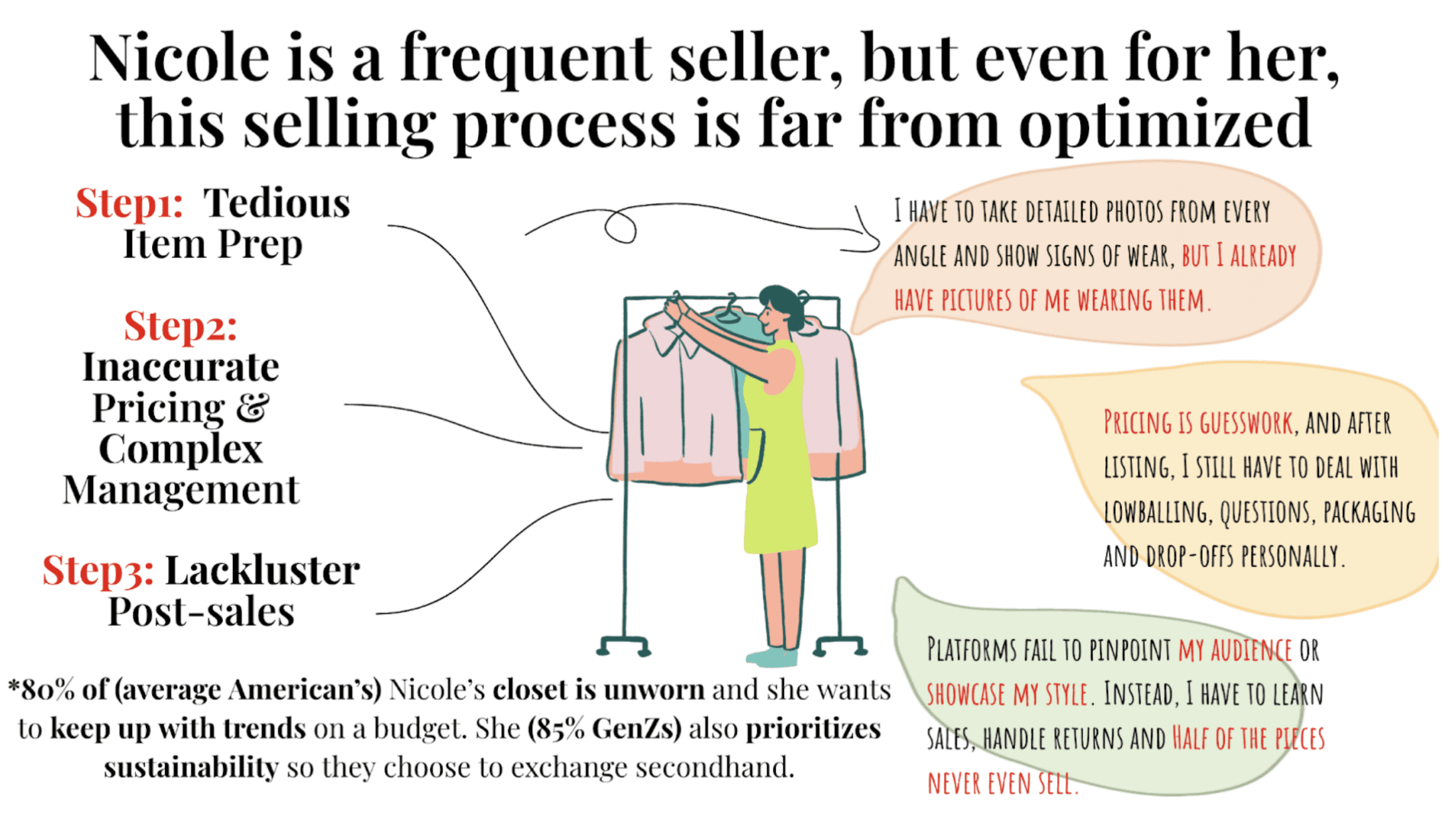
Below is a real buyer example:
Sustainability is important to Victoria, but convenience and trust in the product are equally critical. She values authenticity in the brands she shops from and is wary of promotional- heavy platforms. She has a strong dislike for fast fashion and tends to look for quality, versatile pieces that align with her ethical values .
Victoria primarily shops in person when thrifting and online when buying new. She is increasingly interested in shifting more of her shopping to second- hand online platforms, but only if they offer trust , convenience, and transparency .
Other Behaviors : Adds clothes to cart very frequently and often but the final purchases are not as much
Social media, especially TikTok, Pinterest and Instagram, is where Victoria discovers fashion trends. However, she's increasingly frustrated by the platform's heavy commercialization and prefers content that feels real and relatable. Influencer fatigue has set in , but she still enjoys content that offers genuine recommendations .
Victoria is a busy college student who balances academics, a social life, and staying active on social media. She values individuality and prefers standing out through her style. She also leans towards sustainability by occasionally thrifting her clothes, but primarily enjoys finding unique pieces in- person .
Victoria needs a shopping app that combines the entire process of discovering fashion and buying second- hand items into one seamless platform. This would eliminate her need to switch between different platforms .
She requires a platform that provides detailed product descriptions , high- quality images, and user reviews to verify the condition of thrifted items before purchasing. This would help her feel more confident about buying second- hand online .
She needs a platform that offers curated fashion suggestions based on her style preferences, reducing the time and effort spent browsing through irrelevant listings. This would make it easier for her to find the items she's most likely to buy .
Victoria finds it frustrating to switch between multiple platforms.She uses social media to discover trends, search engines to find similar items, and eCommerce platforms to buy clothes. This fragmented process is time- consuming and annoying.
Having been scammed before by counterfeit products , Victoria is now skeptical of overly promotional content and online sellers. She struggles to find reliable platforms where she can safely purchase second- hand fashion without risk .
While she enjoys finding unique fashion pieces, sifting through an overwhelming amount of listings on platforms like Depop or eBay can be exhausting. The lack of personalized, easy- to- navigate options makes the shopping experience tedious .
ONLINE SHOPPING SATISFACTION
FASHION INSPIRATIONS:
MODERATE (2k/MONTH)
SHOPPING BEHAVIOR :
College Social Thrifter
Second-hand Retail
Social Media driven Retail
ABOUT VICTORIA
PAIN POINTS
Online Retail
INCOME LEVEL
GENDER
FEMALE
AGE
21
"I find fashion inspirations on
Pinterest and tiktok, then go thrifting
to recreate these aesthetics I enjoy."
NEEDS
MVP
————————————————————————————————————————————————————————————————————————————————————————————————————
Building the MVP, Architecture and Design Choices
Where I led,
Frontend in React Native focused on fast navigation and visually rich cards. Shared components, strict typing, and a lightweight design system so screens feel intentional on every device.
Backend in Next.js with REST endpoints, JWT authentication, and MongoDB collections for users, items, moodboards, and transactions. Clear API contracts that mirror the UI model so handoffs are simple.
Analytics with PostHog for invite trees, saves, follows, offers, and checkout outcomes. Session replay with FullStory during onboarding studies to see friction, not imagine it.
From sketch to code
Paper sketches to find flow before pixels. I draw the happy path first, then the failure states.
Figma prototypes with a small token set for type, spacing, and elevation. I use Smart Animate only where motion teaches.
Task based usability passes with five to ten real users per loop. I ask for narration and watch the cursor in silence for the first pass.
React Native build in short slices. Each slice ends with an observable event in PostHog so learning never waits for a big release.
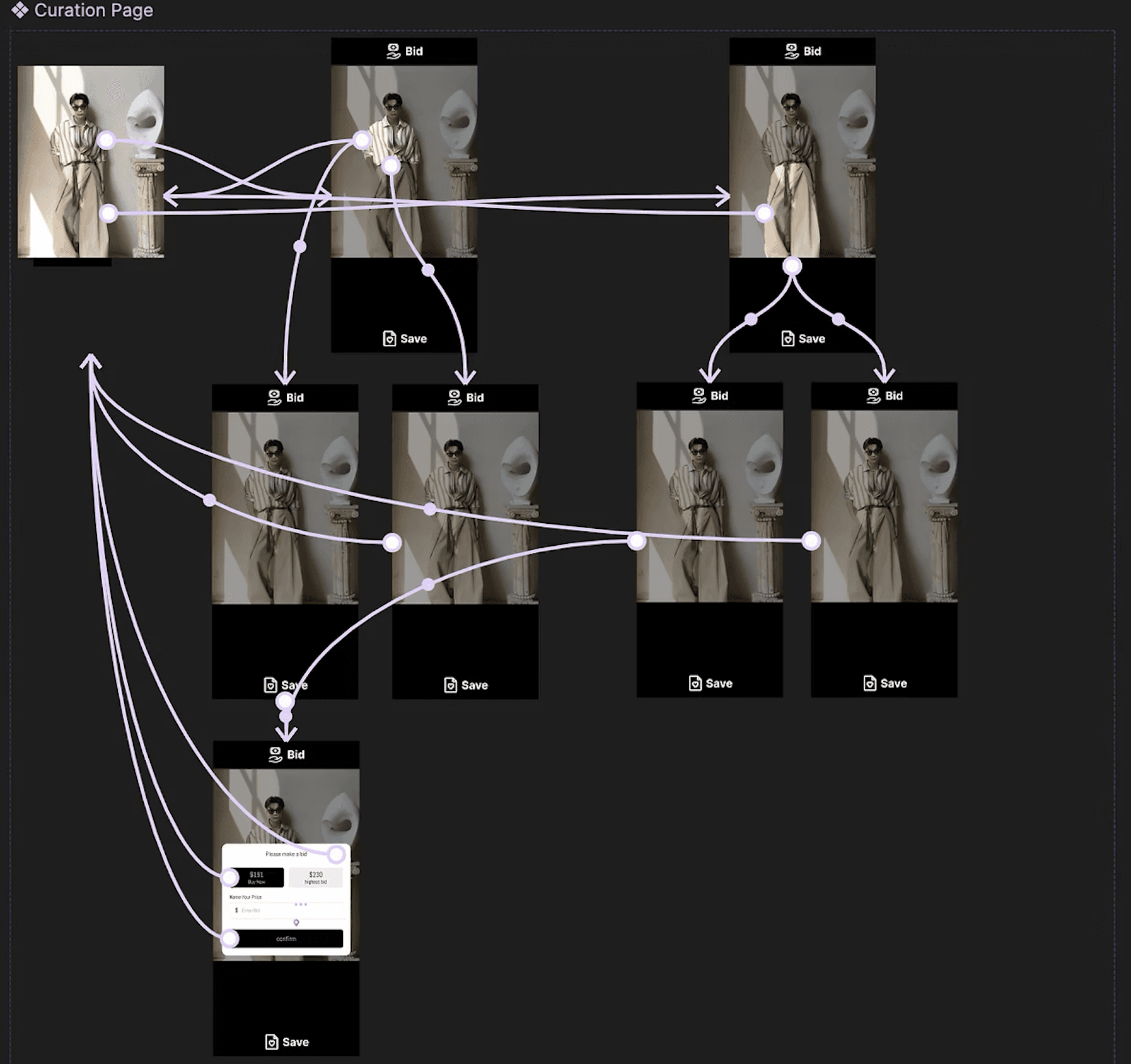
9 MVP versions at a glance
V0 paper flows. Outside in. Can a person explain the product back to me after one minute.
V1 gray wireframes. Navigation, information order, and copy tone. Measure time to complete first save on an InVision style clickthrough.
V2 clickable Figma. Micro interactions that teach. Remove any animation that delays understanding.
V3 React Native navigation spike. Prove that the stack and routing feel snappy on older phones.
V4 onboarding minimal set. Google sign in, pick style genres, add height and waist, show a real personalized board within thirty seconds.
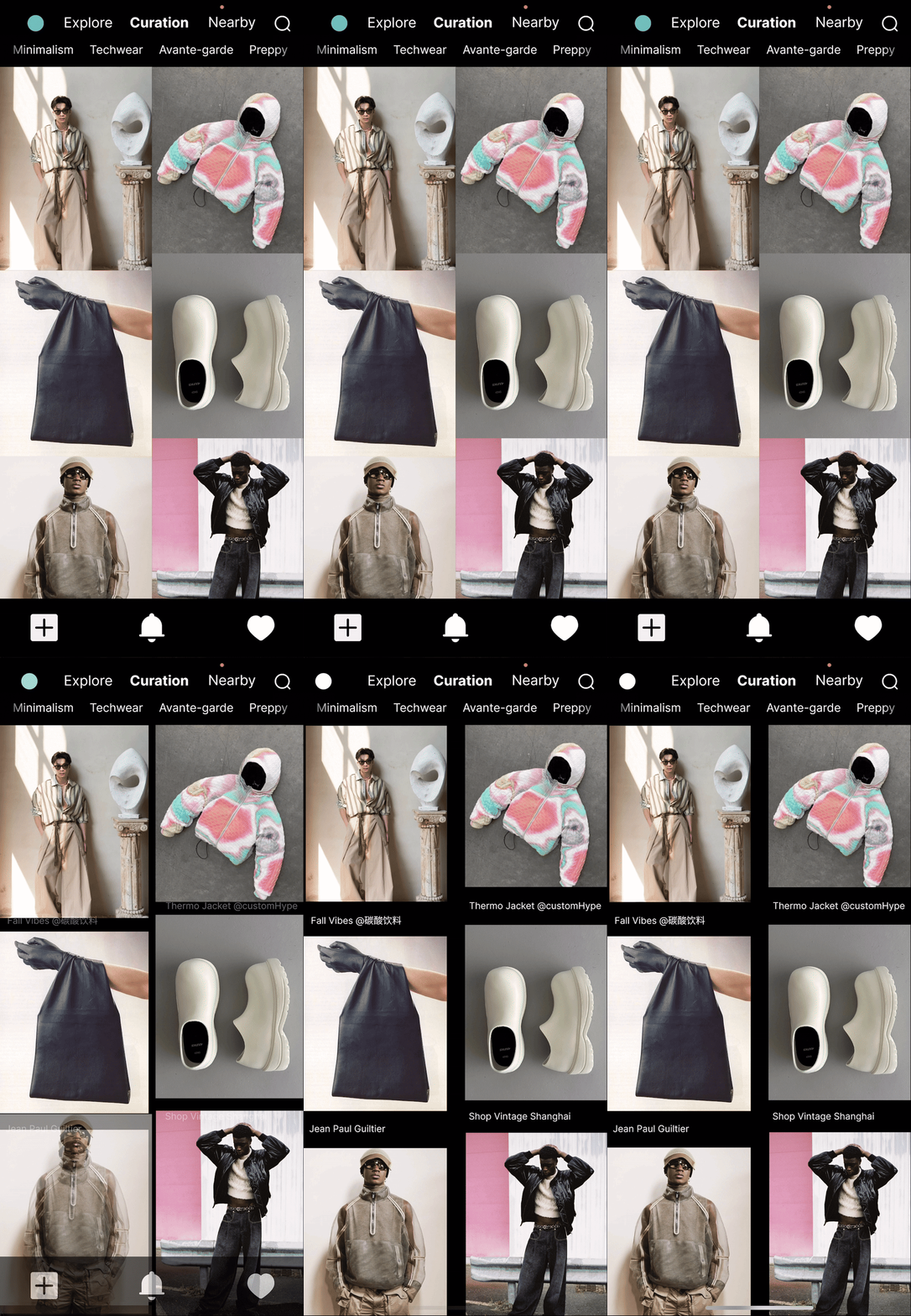
V5 moodboard first home. Replace mixed grids with composed looks. Measure saves per session and follow rate.
V6 listing storyteller. Require three styled photos and a short caption that gives context. Quality of supply improves and saves rise.
V7 trust layer. Ratings, visible trade history, and a short credibility panel before the offer step. View to offer improves in tests.
V8 binding offer. Clear timer, clear terms, and visible credibility. Ghosted threads fall and accepted offers rise.
Each version shipped with a one page note. Hypothesis, change, evidence, and a keep or kill decision. No feature progressed without a written reason to exist.
Subtitle
Title
Subtitle
Title

Subtitle
Title
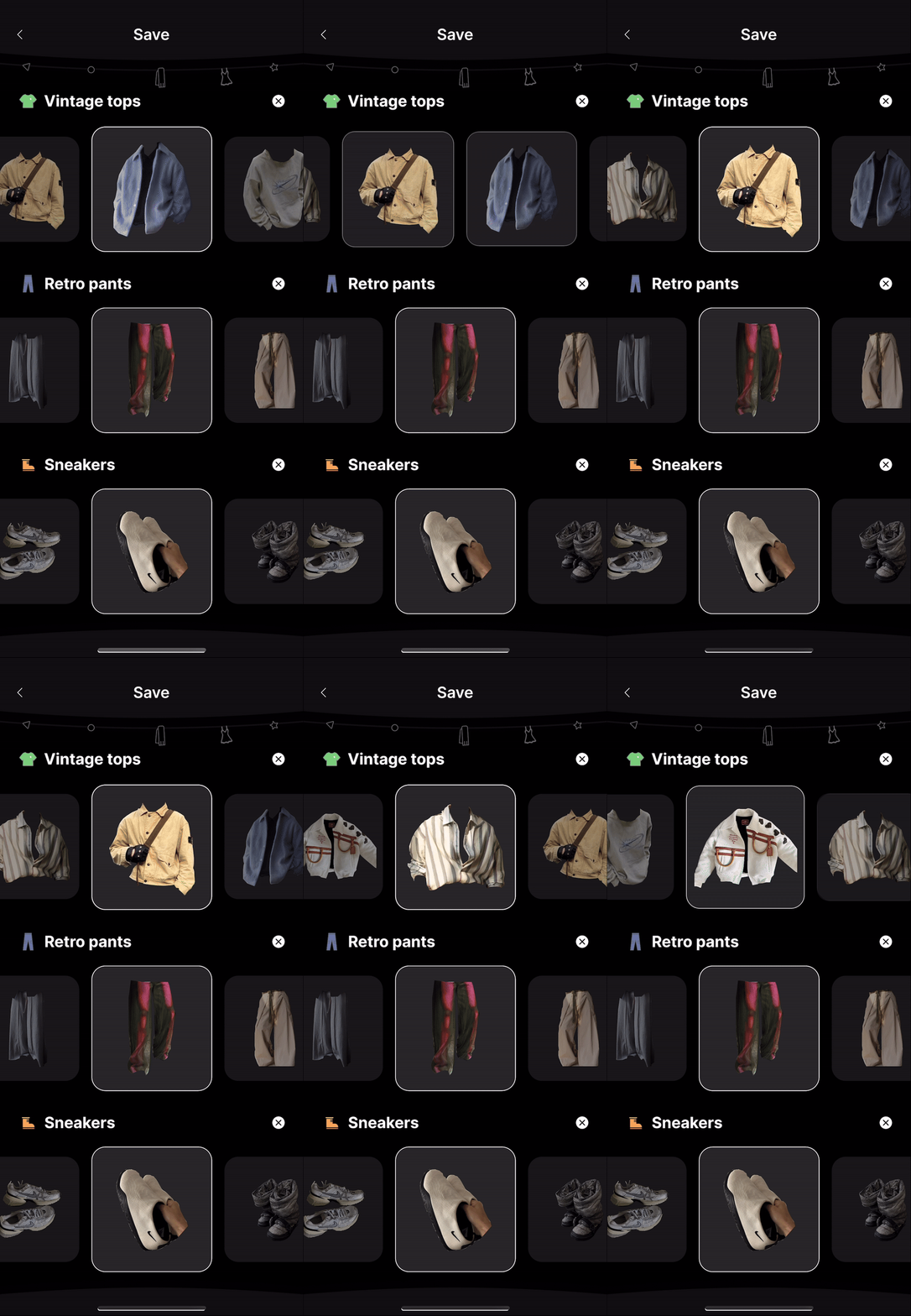
Design choices that mattered
Moodboard as the home surface. Taste and composition lead decision making.
Onboarding in thirty seconds or less. The first personalized board appears immediately after size and style choices. People feel seen and stay.
Listing flow that asks for story. Three styled photos and a caption are required so buyers see vibe and fit, not only price.
Offer flow with credibility and time. The default is a serious offer with a clear window. Sellers feel protected and buyers gain clarity.
Testing and instrumentation
Device matrix with two recent iPhones and one older model. Cold start time and scroll performance are measured on each build.
Event naming standard. Verb object pairs, consistent properties for user, session, and experiment. Every critical step has an event.
A B switches behind simple flags. Rollouts move from staff to beta to public. If a flag does not move the target metric in two weeks it is removed.
Session replay only where consent is granted. I review replays with the team so we debate reality, not opinions.
(Artifact: events dictionary extract) (Artifact: flag control panel) (Artifact: replay clips library)
Performance and resilience
Image compression and lazy loading on every card. Skeletons rather than spinners. Cached queries for scroll back.
Network error states that teach the next step. People always know what to do.
Security basics in the client. Tokens stored in the secure keychain, cleared on logout, and never placed in logs.
Go-to-market
————————————————————————————————————————————————————————————————————————————————————————————————————
Phase 1: Seller-First Seeding
Cohost vintage markets in fashion-forward cities (NYC, LA, college towns) to meet and onboard high-quality sellers in person.
Focus on power sellers: fashion students, curated vintage brands, creators with large closets — giving them tools, spotlight, and incentives to list regularly.
Maintain invite-only supply to drive seller pride and early trust.
Phase 2: Social Virality → Brand Pull
Launch “Outfits from girls on my campus” TikTok series to spark buyer interest organically through styled fits.
Use AI-generated moodboard tools as viral hooks — users share aesthetic outfits created from real inventory.
Leverage founder-led content to tell the story, show taste, and connect directly with Gen Z.
Phase 3: Flip Demand Loop
Once top sellers are listing consistently, use their following + Quture’s discovery UX to activate buyer demand.
Push weekly drops by aesthetic, styled by Quture’s AI to reduce friction and increase delight.
Capture buyer interest through exclusivity: early access, styling suggestions, and personalized feeds.
Accomplishment
————————————————————————————————————————————————————————————————————————————————————————————————————
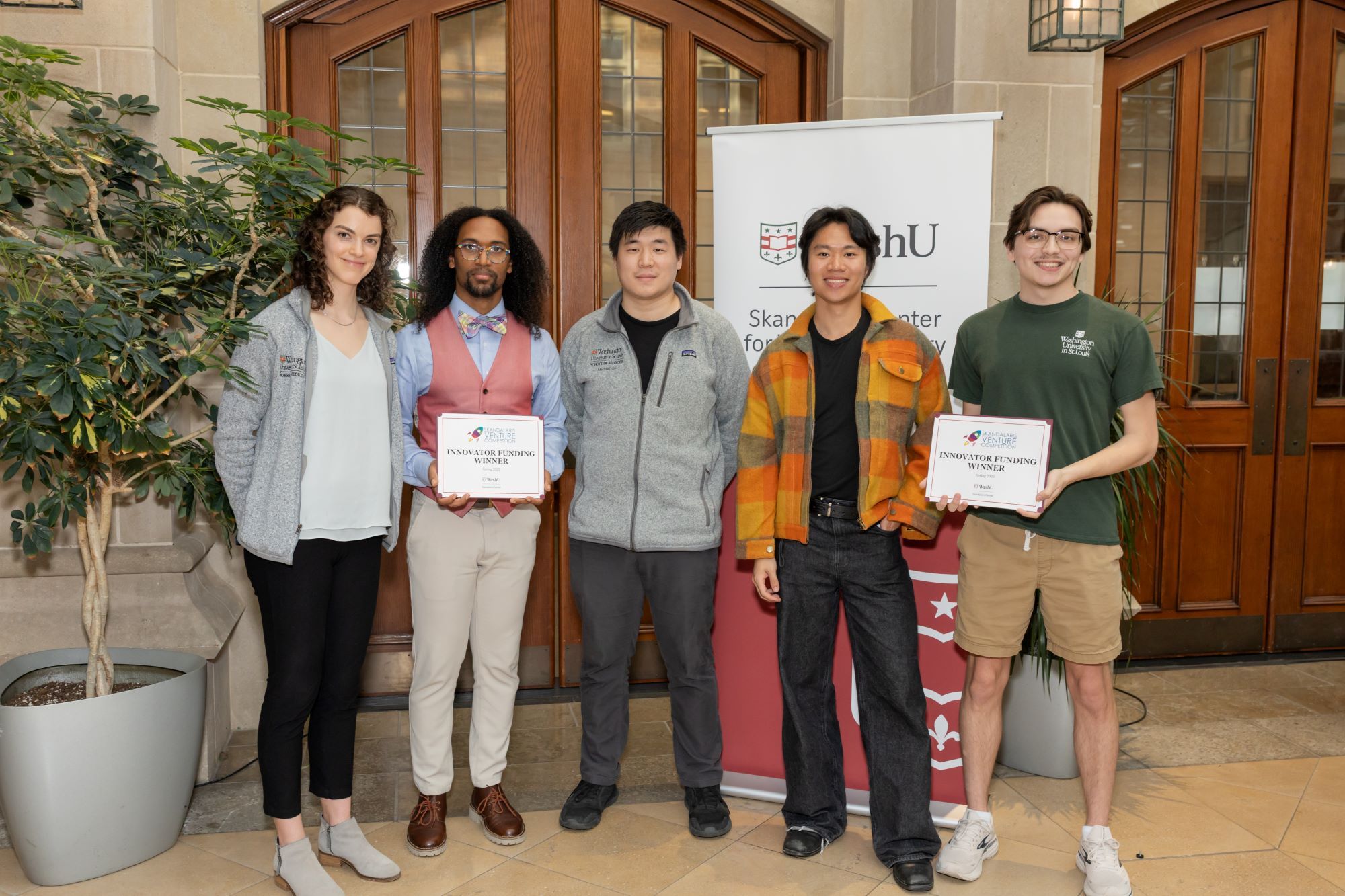
The results validated our hypotheses and positioned us for scale.
Traction: 30K downloads, 10K MAUs, $300K GMV in 18 months.
Engagement: 70% buyer-seller overlap → network flywheel.
Unit Economics: LTV:CAC = 3.4:1; profitable from Day 1 of beta.
Community: Partnerships with Strike & Armour, 1K+ followers, 15K+ likes in 40 days.
Funding: $50K non-dilutive via grants + pitch competitions.
Learnings
————————————————————————————————————————————————————————————————————————————————————————————————————
I. The Call to Build
We started Quture with a vision: make secondhand fashion exciting again.
Not just sustainable — but expressive, curated, alive.
We believed Gen Z deserved a fashion experience that felt intuitive, creative, and deeply personal.
So we built. Designed. Researched. Interviewed 300+ users.
Launched an MVP on campus.
140 downloads. 50+ hours of usage in a week.
Real traction. Real users. Real belief.
II. The Trials and the Turns
But building something people say they want is easy.
Building something they return to — that’s the real test.
We shipped fast, iterated often, and learned that every delay in action was a delay in truth.
We pivoted from marketplace-first to moodboard-first.
From open access to curated invites.
From assumptions to reality checks.
And we learned that clarity doesn’t come in brainstorms.
It comes in shipping, watching, adjusting, again and again.
III. The Harder Truths
We learned the weight of misalignment.
That skill doesn’t replace ownership.
That momentum dies when the people in the room don’t feel urgency.
We saw how rare it is to find collaborators who are both exceptional and committed.
And how everything breaks when no one takes the uncomfortable initiative.
That taught me what kind of person I want to be.
And what kind of people I need to build with.
IV. The Unexpected Blow
Near the end, Quture gained real traction — and with it, real risk.
We were hit by card testers exploiting our checkout flow.
It forced us to learn about fraud systems, security protocols, and the operational pain that comes with attention.
A reminder that the world doesn't wait until you're ready.
V. What is next for me?
Quture didn’t end the way we planned.
But it gave me something far more valuable than a startup exit
Speed in uncertainty
Taste in product judgment
Real scars from real stakes
And a hunger for harder problems, higher standards, and better teams
I’m not interested in building things that look good in a portfolio.
I want to build what matters, with people who can hold the weight.

Quture - AI Fashion Marketplace for Gen Z
GenZ's all-in-one AI fashion marketplace where style finds you.
A viral thrifting app for Gen Z fashion enthusiasts, 10k users, $300k GMV, $50k+ raised.
TLDR I built Quture to make secondhand fashion joyful again. Over 18 months we reached 30K downloads, 10K monthly active users, and 300K GMV while learning hard lessons about product judgment, execution speed, team standards, and fraud resilience.
This case study presents the WHY, Methodology, and Evidence behind the work.
It reads like proof, showcasing my passion, determination, and lessons learned as we work as a team to help GenZs find their true aesthetic identity.
Think Pinterest where every pin is instantly purchasable from real closets.
9 MVPs shipped
5 college campuses reached
30K total downloads
10K monthly active users
300K GMV in 18 months
Role
Product Manager UX/CX Lead Go-To-Market Full-stack developer
Timeline
2024 ~ 2025
Skills
Figma Xcode Notion Jira Airtable Framer
Overview
————————————————————————————————————————————————————————————————————————————————————————————————————
Problem
Secondhand fashion online is messy. It’s hard to discover your style, trust sellers, or enjoy the process.
Solution
Quture turns secondhand shopping into a curated, social, and personalized experience, imagine buying straight from your pinterest fashion moodboard.
Mission
GenZ's all-in-one AI fashion marketplace where style finds you.
Why build a fashion marketplace?
————————————————————————————————————————————————————————————————————————————————————————————————————
Since high school,
I’ve been obsessed with curating my daily outfits.
Not just to look good, but because fashion is how I express who I am. It’s my personal philosophy, made wearable.
Over the years,
I tried everything to document my style evolution and connect with others who shared the same obsession. I tested apps. Joined fashion forums. Searched for communities where people actually exchanged clothes and inspiration. Nothing clicked.
Eventually, I resorted to the most manual process imaginable: snapping photos of my outfits and saving them in my Notes app. That was my style archive. (As shown below)
But,
When it came to finding new pieces, the experience was equally frustrating. I’d scroll endlessly through clothing sites, only to find nothing that matched my taste or my budget. Either it was the wrong vibe, or way too expensive.
I realized something bigger was broken.
There was no smooth way to explore fashion online. No serendipity. No sense of discovery. Everything was engineered to push a purchase, not nurture self-expression. And as someone deeply passionate about fashion, I felt disconnected, from the joy of sharing my style, from finding others like me, from any real fashion community that got it.
Meanwhile, the fashion industry is worth over $1.84 trillion,
Yet it's wildly fragmented and outdated in how it connects creators, curators, and consumers.
Gen Z isn’t looking for polished ads or soulless storefronts. We value authenticity. We follow each other’s style. We trust what our friends, peers, and favorite creators wear. That’s where inspiration—and influence—really happens.
So I started thinking:
What if there was a Pinterest you could actually shop from?
A space where outfit inspiration could flow straight into a secondhand marketplace.
Where discovery felt natural, and curation had value.
That’s when the idea for Quture was born.
Our Northstar & Scope
————————————————————————————————————————————————————————————————————————————————————————————————————
China vs US, Sitting at A Crossroad
To decide where to launch first, we spoke with over 100 shoppers and thrift store owners across China and the U.S.
China has its own thriving online fashion culture,
Red Note being a standout example and a big influence on our product’s UI/UX. But despite the creative energy, secondhand still carries social stigma there. More importantly, China lacks the trust rails, verification, payment protection, and reliable logistics—that secondhand commerce needs to thrive.
The U.S. tells a very different story.
Here, Gen Z embraces secondhand as a mix of identity and value. The infrastructure is solid. The culture is ready. Trust is expected, and supported. That made our decision clear: build in North America first, revisit China when cultural norms and tech rails catch up.
Two platforms helped shape our vision:
Red Note (China) and Pinterest (U.S.).
As a power user of both, I saw how life-changing it is to visualize and curate your ideal aesthetic—and how empowering it feels to share that with the world.
Now imagine that experience, brought to life inside the most expressive, fast-moving, and community-driven industry of all: fashion.
Where every day is about finding your fit. Your vibe. Your people.
What We’re Building
We’re creating an online fashion marketplace that feels like walking through SoHo on a Saturday—
full of discovery, inspiration, and authentic self-expression.
You’re surrounded by people who get your taste.
You see something. You save it. Make an offer. Or pass in a second.
Trust is built-in: verified sellers, transparent history, secure payouts.
AI does the heavy lifting—style matching, smart fit cues, taste-based ranking, and fraud detection that protects buyers and rewards good sellers fast.
Guardrails
From day one, we’ve focused on depth before breadth.
We’re winning tight campus networks and semi-pro sellers first—before expanding city by city.
We avoid generic feeds. No exposure for unverified sellers. No payment flows that skip risk checks. Every feature must lift one of three things:
activation, trust, or repeat exchange, or it doesn’t ship.
Our North Star
One place where secondhand feels personal, safe, and fast.
Every visit answers three questions, quickly and clearly:
Do I want it?
Does it fit me?
Can I trust the seller?
User Research
————————————————————————————————————————————————————————————————————————————————————————————————————
Understanding how Gen Z discovers and exchanges fashion now
I led and conducted 300+ interviews across WashU, NYU, and Parsons with MVP analytics to separate what people say from what they do.
What we learned from these interviews:
72%
GenZ fashion lovers get inspiration from social media (TikTok & Pinterest), while
1 in 4
GenZ purchase the fashion pieces on these social platforms.
64%
GenZ secondhand shoppers are overwhelmed by the cluttered feed page of exchange platforms, discouraging them to shop for secondhand pieces online.
58%
GenZ shoppers navigate across 3+ platforms, a dozen tabs to to shop for fashion pieces that fit their style.
GenZ shoppers browse in two modes:
Passive background scrolling, quick saves, low intent
Active decision mode, needs fit, vibe, and trust on one screen
How did we approach customer discovery?
Contextual interviews and campus intercepts, short diary studies of buy and sell attempts, PostHog funnels from MVP week for time to first save and offer attempts, JTBD mapping to turn quotes into jobs.
Fashion enthusiasts tell us over and over again
“I love shopping, but after opening 30 tabs, the decision fatigue really kicks in. I wish I could have outfits recommended to me and sold at the same place."
Why this matters?
Lead with taste and trust. Ask for size and style tags only if the payoff is instant. Treat credibility as part of discovery, not a late step.
Demographic
————————————————————————————————————————————————————————————————————————————————————————————————————
Who Are We Building For? (User Empathy + Data-Driven Insights)
Primary Audience:
Age: 18–25 Gender: ~80% Female Generation: Gen Z
Psychographics: Fashion-forward but budget- or sustainability-conscious Inspired by Pinterest, TikTok, Depop, but frustrated by clunky UX and scattered experiences Seeks creative expression through clothing and social validation from community-based engagement
How We Identified This: Conducted 300+ structured interviews, primarily on college campuses (WashU, NYU,Parsons) Ran usage tests during MVP week: 140 downloads, 50+ active hours in 7 days Parsed qualitative sentiment from Reddit (Depop/eBay communities) and Gen Z focus groups Created 5 personas using affinity mapping and JTBD (Jobs To Be Done) frameworks A/B tested early landing page copy + visuals across IG and TikTok, tracked CTR by persona
Representative Persona – “Bella R.” 20 y/o college student Scrolls IG + Pinterest nightly Uses Depop but hates lowballers and stale aesthetic Wants clothes with vibe, not just price, thinks “style = self” Trusts referrals more than ads
User Journey & Pain Points
————————————————————————————————————————————————————————————————————————————————————————————————————
USER JOURNEY (Execution + Product Thinking)
1. Awareness & Curiosity (Problem Discovery) Entry Channels: TikTok virality, friend invites, college flyers, outfit-of-the-day reposts Signal: “Why haven’t I heard of this before?” Data Source: UTM-tagged links, invite trees, event-based PostHog tracking
2. Onboarding & Personalization (Activation) Flow: Google Sign-in Upload style genres (from predefined aesthetic clusters) Input height + waist size (used for future styling AI) Goal: Personalization within 30 seconds Insights Used: Heatmaps from MVP v1, recorded sessions via FullStory, rage-click analytics
3. Exploration (Engagement) Modeled after: TikTok + Pinterest hybrid UX Action: Scroll curated fits, save items, follow stylistic users Unique Touch: Moodboard-based browsing over raw product feeds Learnings: Users spent 2.3x longer on moodboards than thrift feed (A/B Group Study, n=60)
4. Exchange (Core Loop) Listing: Sellers upload 3+ styled photos with storytelling captions Buying: No lowballing. Offers are binding, time-limited Trust Layer: Star ratings, visible trade history, group invites Tools Used: Funnel dropoff analysis, exit surveys for ghosting pain points, seller UX diary studies
5. Community & Retention (Delight) Post-sale: AI styles your piece into new looks Gamification: Earn points, badges, invites for being early stylist Network Effect: Each user brings 1.8 others (tracked via viral coefficient during MVP launch) Ongoing Tactics: Referral campaigns with exclusive seller club + leaderboard rankings
As seen in the user journey above, the average users jump across 3+ platforms, going through a dozen steps to go from, discovery to checking out, often resulting in 90+% cart abandonment.
Below is a real buyer example:
Sustainability is important to Victoria, but convenience and trust in the product are equally critical. She values authenticity in the brands she shops from and is wary of promotional- heavy platforms. She has a strong dislike for fast fashion and tends to look for quality, versatile pieces that align with her ethical values .
Victoria primarily shops in person when thrifting and online when buying new. She is increasingly interested in shifting more of her shopping to second- hand online platforms, but only if they offer trust , convenience, and transparency .
Other Behaviors : Adds clothes to cart very frequently and often but the final purchases are not as much
Social media, especially TikTok, Pinterest and Instagram, is where Victoria discovers fashion trends. However, she's increasingly frustrated by the platform's heavy commercialization and prefers content that feels real and relatable. Influencer fatigue has set in , but she still enjoys content that offers genuine recommendations .
Victoria is a busy college student who balances academics, a social life, and staying active on social media. She values individuality and prefers standing out through her style. She also leans towards sustainability by occasionally thrifting her clothes, but primarily enjoys finding unique pieces in- person .
Victoria needs a shopping app that combines the entire process of discovering fashion and buying second- hand items into one seamless platform. This would eliminate her need to switch between different platforms .
She requires a platform that provides detailed product descriptions , high- quality images, and user reviews to verify the condition of thrifted items before purchasing. This would help her feel more confident about buying second- hand online .
She needs a platform that offers curated fashion suggestions based on her style preferences, reducing the time and effort spent browsing through irrelevant listings. This would make it easier for her to find the items she's most likely to buy .
Victoria finds it frustrating to switch between multiple platforms.She uses social media to discover trends, search engines to find similar items, and eCommerce platforms to buy clothes. This fragmented process is time- consuming and annoying.
Having been scammed before by counterfeit products , Victoria is now skeptical of overly promotional content and online sellers. She struggles to find reliable platforms where she can safely purchase second- hand fashion without risk .
While she enjoys finding unique fashion pieces, sifting through an overwhelming amount of listings on platforms like Depop or eBay can be exhausting. The lack of personalized, easy- to- navigate options makes the shopping experience tedious .
ONLINE SHOPPING SATISFACTION
FASHION INSPIRATIONS:
MODERATE (2k/MONTH)
SHOPPING BEHAVIOR :
College Social Thrifter
Second-hand Retail
Social Media driven Retail
ABOUT VICTORIA
PAIN POINTS
Online Retail
INCOME LEVEL
GENDER
FEMALE
AGE
21
"I find fashion inspirations on
Pinterest and tiktok, then go thrifting
to recreate these aesthetics I enjoy."
NEEDS
MVP
————————————————————————————————————————————————————————————————————————————————————————————————————
Building the MVP, Architecture and Design Choices
Where I led,
Frontend in React Native focused on fast navigation and visually rich cards. Shared components, strict typing, and a lightweight design system so screens feel intentional on every device.
Backend in Next.js with REST endpoints, JWT authentication, and MongoDB collections for users, items, moodboards, and transactions. Clear API contracts that mirror the UI model so handoffs are simple.
Analytics with PostHog for invite trees, saves, follows, offers, and checkout outcomes. Session replay with FullStory during onboarding studies to see friction, not imagine it.
From sketch to code
Paper sketches to find flow before pixels. I draw the happy path first, then the failure states.
Figma prototypes with a small token set for type, spacing, and elevation. I use Smart Animate only where motion teaches.
Task based usability passes with five to ten real users per loop. I ask for narration and watch the cursor in silence for the first pass.
React Native build in short slices. Each slice ends with an observable event in PostHog so learning never waits for a big release.
9 MVP versions at a glance
V0 paper flows. Outside in. Can a person explain the product back to me after one minute.
V1 gray wireframes. Navigation, information order, and copy tone. Measure time to complete first save on an InVision style clickthrough.
V2 clickable Figma. Micro interactions that teach. Remove any animation that delays understanding.
V3 React Native navigation spike. Prove that the stack and routing feel snappy on older phones.
V4 onboarding minimal set. Google sign in, pick style genres, add height and waist, show a real personalized board within thirty seconds.
V5 moodboard first home. Replace mixed grids with composed looks. Measure saves per session and follow rate.
V6 listing storyteller. Require three styled photos and a short caption that gives context. Quality of supply improves and saves rise.
V7 trust layer. Ratings, visible trade history, and a short credibility panel before the offer step. View to offer improves in tests.
V8 binding offer. Clear timer, clear terms, and visible credibility. Ghosted threads fall and accepted offers rise.
Each version shipped with a one page note. Hypothesis, change, evidence, and a keep or kill decision. No feature progressed without a written reason to exist.
Subtitle
Title
Subtitle
Title
Subtitle
Title
Design choices that mattered
Moodboard as the home surface. Taste and composition lead decision making.
Onboarding in thirty seconds or less. The first personalized board appears immediately after size and style choices. People feel seen and stay.
Listing flow that asks for story. Three styled photos and a caption are required so buyers see vibe and fit, not only price.
Offer flow with credibility and time. The default is a serious offer with a clear window. Sellers feel protected and buyers gain clarity.
Testing and instrumentation
Device matrix with two recent iPhones and one older model. Cold start time and scroll performance are measured on each build.
Event naming standard. Verb object pairs, consistent properties for user, session, and experiment. Every critical step has an event.
A B switches behind simple flags. Rollouts move from staff to beta to public. If a flag does not move the target metric in two weeks it is removed.
Session replay only where consent is granted. I review replays with the team so we debate reality, not opinions.
(Artifact: events dictionary extract) (Artifact: flag control panel) (Artifact: replay clips library)
Performance and resilience
Image compression and lazy loading on every card. Skeletons rather than spinners. Cached queries for scroll back.
Network error states that teach the next step. People always know what to do.
Security basics in the client. Tokens stored in the secure keychain, cleared on logout, and never placed in logs.
Go-to-market
————————————————————————————————————————————————————————————————————————————————————————————————————
Phase 1: Seller-First Seeding
Cohost vintage markets in fashion-forward cities (NYC, LA, college towns) to meet and onboard high-quality sellers in person.
Focus on power sellers: fashion students, curated vintage brands, creators with large closets — giving them tools, spotlight, and incentives to list regularly.
Maintain invite-only supply to drive seller pride and early trust.
Phase 2: Social Virality → Brand Pull
Launch “Outfits from girls on my campus” TikTok series to spark buyer interest organically through styled fits.
Use AI-generated moodboard tools as viral hooks — users share aesthetic outfits created from real inventory.
Leverage founder-led content to tell the story, show taste, and connect directly with Gen Z.
Phase 3: Flip Demand Loop
Once top sellers are listing consistently, use their following + Quture’s discovery UX to activate buyer demand.
Push weekly drops by aesthetic, styled by Quture’s AI to reduce friction and increase delight.
Capture buyer interest through exclusivity: early access, styling suggestions, and personalized feeds.
Accomplishment
————————————————————————————————————————————————————————————————————————————————————————————————————
The results validated our hypotheses and positioned us for scale.
Traction: 30K downloads, 10K MAUs, $300K GMV in 18 months.
Engagement: 70% buyer-seller overlap → network flywheel.
Unit Economics: LTV:CAC = 3.4:1; profitable from Day 1 of beta.
Community: Partnerships with Strike & Armour, 1K+ followers, 15K+ likes in 40 days.
Funding: $50K non-dilutive via grants + pitch competitions.
Learnings
————————————————————————————————————————————————————————————————————————————————————————————————————
I. The Call to Build
We started Quture with a vision: make secondhand fashion exciting again.
Not just sustainable — but expressive, curated, alive.
We believed Gen Z deserved a fashion experience that felt intuitive, creative, and deeply personal.
So we built. Designed. Researched. Interviewed 300+ users.
Launched an MVP on campus.
140 downloads. 50+ hours of usage in a week.
Real traction. Real users. Real belief.
II. The Trials and the Turns
But building something people say they want is easy.
Building something they return to — that’s the real test.
We shipped fast, iterated often, and learned that every delay in action was a delay in truth.
We pivoted from marketplace-first to moodboard-first.
From open access to curated invites.
From assumptions to reality checks.
And we learned that clarity doesn’t come in brainstorms.
It comes in shipping, watching, adjusting, again and again.
III. The Harder Truths
We learned the weight of misalignment.
That skill doesn’t replace ownership.
That momentum dies when the people in the room don’t feel urgency.
We saw how rare it is to find collaborators who are both exceptional and committed.
And how everything breaks when no one takes the uncomfortable initiative.
That taught me what kind of person I want to be.
And what kind of people I need to build with.
IV. The Unexpected Blow
Near the end, Quture gained real traction — and with it, real risk.
We were hit by card testers exploiting our checkout flow.
It forced us to learn about fraud systems, security protocols, and the operational pain that comes with attention.
A reminder that the world doesn't wait until you're ready.
V. What is next for me?
Quture didn’t end the way we planned.
But it gave me something far more valuable than a startup exit
Speed in uncertainty
Taste in product judgment
Real scars from real stakes
And a hunger for harder problems, higher standards, and better teams
I’m not interested in building things that look good in a portfolio.
I want to build what matters, with people who can hold the weight.
Quture - AI Fashion Marketplace for Gen Z
GenZ's all-in-one AI fashion marketplace where style finds you.
A viral thrifting app for Gen Z fashion enthusiasts, 10k users, $300k GMV, $50k+ raised.
TLDR I built Quture to make secondhand fashion joyful again. Over 18 months we reached 30K downloads, 10K monthly active users, and 300K GMV while learning hard lessons about product judgment, execution speed, team standards, and fraud resilience.
This case study presents the WHY, Methodology, and Evidence behind the work.
It reads like proof, showcasing my passion, determination, and lessons learned as we work as a team to help GenZs find their true aesthetic identity.
Think Pinterest where every pin is instantly purchasable from real closets.
9 MVPs shipped
5 college campuses reached
30K total downloads
10K monthly active users
300K GMV in 18 months
Role
Product Manager UX/CX Lead Go-To-Market Full-stack developer
Timeline
2024 ~ 2025
Skills
Figma Xcode Notion Jira Airtable Framer
Overview
————————————————————————————————————————————————————————————————————————————————————————————————————
Problem
Secondhand fashion online is messy. It’s hard to discover your style, trust sellers, or enjoy the process.
Solution
Quture turns secondhand shopping into a curated, social, and personalized experience, imagine buying straight from your pinterest fashion moodboard.
Mission
GenZ's all-in-one AI fashion marketplace where style finds you.
Why build a fashion marketplace?
————————————————————————————————————————————————————————————————————————————————————————————————————
Since high school,
I’ve been obsessed with curating my daily outfits.
Not just to look good, but because fashion is how I express who I am. It’s my personal philosophy, made wearable.
Over the years,
I tried everything to document my style evolution and connect with others who shared the same obsession. I tested apps. Joined fashion forums. Searched for communities where people actually exchanged clothes and inspiration. Nothing clicked.
Eventually, I resorted to the most manual process imaginable: snapping photos of my outfits and saving them in my Notes app. That was my style archive. (As shown below)
But,
When it came to finding new pieces, the experience was equally frustrating. I’d scroll endlessly through clothing sites, only to find nothing that matched my taste or my budget. Either it was the wrong vibe, or way too expensive.
I realized something bigger was broken.
There was no smooth way to explore fashion online. No serendipity. No sense of discovery. Everything was engineered to push a purchase, not nurture self-expression. And as someone deeply passionate about fashion, I felt disconnected, from the joy of sharing my style, from finding others like me, from any real fashion community that got it.
Meanwhile, the fashion industry is worth over $1.84 trillion,
Yet it's wildly fragmented and outdated in how it connects creators, curators, and consumers.
Gen Z isn’t looking for polished ads or soulless storefronts. We value authenticity. We follow each other’s style. We trust what our friends, peers, and favorite creators wear. That’s where inspiration—and influence—really happens.
So I started thinking:
What if there was a Pinterest you could actually shop from?
A space where outfit inspiration could flow straight into a secondhand marketplace.
Where discovery felt natural, and curation had value.
That’s when the idea for Quture was born.
Our Northstar & Scope
————————————————————————————————————————————————————————————————————————————————————————————————————
China vs US, Sitting at A Crossroad
To decide where to launch first, we spoke with over 100 shoppers and thrift store owners across China and the U.S.
China has its own thriving online fashion culture,
Red Note being a standout example and a big influence on our product’s UI/UX. But despite the creative energy, secondhand still carries social stigma there. More importantly, China lacks the trust rails, verification, payment protection, and reliable logistics—that secondhand commerce needs to thrive.
The U.S. tells a very different story.
Here, Gen Z embraces secondhand as a mix of identity and value. The infrastructure is solid. The culture is ready. Trust is expected, and supported. That made our decision clear: build in North America first, revisit China when cultural norms and tech rails catch up.
Two platforms helped shape our vision:
Red Note (China) and Pinterest (U.S.).
As a power user of both, I saw how life-changing it is to visualize and curate your ideal aesthetic—and how empowering it feels to share that with the world.
Now imagine that experience, brought to life inside the most expressive, fast-moving, and community-driven industry of all: fashion.
Where every day is about finding your fit. Your vibe. Your people.
What We’re Building
We’re creating an online fashion marketplace that feels like walking through SoHo on a Saturday—
full of discovery, inspiration, and authentic self-expression.
You’re surrounded by people who get your taste.
You see something. You save it. Make an offer. Or pass in a second.
Trust is built-in: verified sellers, transparent history, secure payouts.
AI does the heavy lifting—style matching, smart fit cues, taste-based ranking, and fraud detection that protects buyers and rewards good sellers fast.
Guardrails
From day one, we’ve focused on depth before breadth.
We’re winning tight campus networks and semi-pro sellers first—before expanding city by city.
We avoid generic feeds. No exposure for unverified sellers. No payment flows that skip risk checks. Every feature must lift one of three things:
activation, trust, or repeat exchange, or it doesn’t ship.
Our North Star
One place where secondhand feels personal, safe, and fast.
Every visit answers three questions, quickly and clearly:
Do I want it?
Does it fit me?
Can I trust the seller?
User Research
————————————————————————————————————————————————————————————————————————————————————————————————————
Understanding how Gen Z discovers and exchanges fashion now
I led and conducted 300+ interviews across WashU, NYU, and Parsons with MVP analytics to separate what people say from what they do.
What we learned from these interviews:
72%
GenZ fashion lovers get inspiration from social media (TikTok & Pinterest), while
1 in 4
GenZ purchase the fashion pieces on these social platforms.
64%
GenZ secondhand shoppers are overwhelmed by the cluttered feed page of exchange platforms, discouraging them to shop for secondhand pieces online.
58%
GenZ shoppers navigate across 3+ platforms, a dozen tabs to to shop for fashion pieces that fit their style.
GenZ shoppers browse in two modes:
Passive background scrolling, quick saves, low intent
Active decision mode, needs fit, vibe, and trust on one screen
How did we approach customer discovery?
Contextual interviews and campus intercepts, short diary studies of buy and sell attempts, PostHog funnels from MVP week for time to first save and offer attempts, JTBD mapping to turn quotes into jobs.
Fashion enthusiasts tell us over and over again
“I love shopping, but after opening 30 tabs, the decision fatigue really kicks in. I wish I could have outfits recommended to me and sold at the same place."
Why this matters?
Lead with taste and trust. Ask for size and style tags only if the payoff is instant. Treat credibility as part of discovery, not a late step.
Demographic
————————————————————————————————————————————————————————————————————————————————————————————————————
Who Are We Building For? (User Empathy + Data-Driven Insights)
Primary Audience:
Age: 18–25 Gender: ~80% Female Generation: Gen Z
Psychographics: Fashion-forward but budget- or sustainability-conscious Inspired by Pinterest, TikTok, Depop, but frustrated by clunky UX and scattered experiences Seeks creative expression through clothing and social validation from community-based engagement
How We Identified This: Conducted 300+ structured interviews, primarily on college campuses (WashU, NYU,Parsons) Ran usage tests during MVP week: 140 downloads, 50+ active hours in 7 days Parsed qualitative sentiment from Reddit (Depop/eBay communities) and Gen Z focus groups Created 5 personas using affinity mapping and JTBD (Jobs To Be Done) frameworks A/B tested early landing page copy + visuals across IG and TikTok, tracked CTR by persona
Representative Persona – “Bella R.” 20 y/o college student Scrolls IG + Pinterest nightly Uses Depop but hates lowballers and stale aesthetic Wants clothes with vibe, not just price, thinks “style = self” Trusts referrals more than ads
User Journey & Pain Points
————————————————————————————————————————————————————————————————————————————————————————————————————
USER JOURNEY (Execution + Product Thinking)
1. Awareness & Curiosity (Problem Discovery) Entry Channels: TikTok virality, friend invites, college flyers, outfit-of-the-day reposts Signal: “Why haven’t I heard of this before?” Data Source: UTM-tagged links, invite trees, event-based PostHog tracking
2. Onboarding & Personalization (Activation) Flow: Google Sign-in Upload style genres (from predefined aesthetic clusters) Input height + waist size (used for future styling AI) Goal: Personalization within 30 seconds Insights Used: Heatmaps from MVP v1, recorded sessions via FullStory, rage-click analytics
3. Exploration (Engagement) Modeled after: TikTok + Pinterest hybrid UX Action: Scroll curated fits, save items, follow stylistic users Unique Touch: Moodboard-based browsing over raw product feeds Learnings: Users spent 2.3x longer on moodboards than thrift feed (A/B Group Study, n=60)
4. Exchange (Core Loop) Listing: Sellers upload 3+ styled photos with storytelling captions Buying: No lowballing. Offers are binding, time-limited Trust Layer: Star ratings, visible trade history, group invites Tools Used: Funnel dropoff analysis, exit surveys for ghosting pain points, seller UX diary studies
5. Community & Retention (Delight) Post-sale: AI styles your piece into new looks Gamification: Earn points, badges, invites for being early stylist Network Effect: Each user brings 1.8 others (tracked via viral coefficient during MVP launch) Ongoing Tactics: Referral campaigns with exclusive seller club + leaderboard rankings
As seen in the user journey above, the average users jump across 3+ platforms, going through a dozen steps to go from, discovery to checking out, often resulting in 90+% cart abandonment.
Below is a real buyer example:
Sustainability is important to Victoria, but convenience and trust in the product are equally critical. She values authenticity in the brands she shops from and is wary of promotional- heavy platforms. She has a strong dislike for fast fashion and tends to look for quality, versatile pieces that align with her ethical values .
Victoria primarily shops in person when thrifting and online when buying new. She is increasingly interested in shifting more of her shopping to second- hand online platforms, but only if they offer trust , convenience, and transparency .
Other Behaviors : Adds clothes to cart very frequently and often but the final purchases are not as much
Social media, especially TikTok, Pinterest and Instagram, is where Victoria discovers fashion trends. However, she's increasingly frustrated by the platform's heavy commercialization and prefers content that feels real and relatable. Influencer fatigue has set in , but she still enjoys content that offers genuine recommendations .
Victoria is a busy college student who balances academics, a social life, and staying active on social media. She values individuality and prefers standing out through her style. She also leans towards sustainability by occasionally thrifting her clothes, but primarily enjoys finding unique pieces in- person .
Victoria needs a shopping app that combines the entire process of discovering fashion and buying second- hand items into one seamless platform. This would eliminate her need to switch between different platforms .
She requires a platform that provides detailed product descriptions , high- quality images, and user reviews to verify the condition of thrifted items before purchasing. This would help her feel more confident about buying second- hand online .
She needs a platform that offers curated fashion suggestions based on her style preferences, reducing the time and effort spent browsing through irrelevant listings. This would make it easier for her to find the items she's most likely to buy .
Victoria finds it frustrating to switch between multiple platforms.She uses social media to discover trends, search engines to find similar items, and eCommerce platforms to buy clothes. This fragmented process is time- consuming and annoying.
Having been scammed before by counterfeit products , Victoria is now skeptical of overly promotional content and online sellers. She struggles to find reliable platforms where she can safely purchase second- hand fashion without risk .
While she enjoys finding unique fashion pieces, sifting through an overwhelming amount of listings on platforms like Depop or eBay can be exhausting. The lack of personalized, easy- to- navigate options makes the shopping experience tedious .
ONLINE SHOPPING SATISFACTION
FASHION INSPIRATIONS:
MODERATE (2k/MONTH)
SHOPPING BEHAVIOR :
College Social Thrifter
Second-hand Retail
Social Media driven Retail
ABOUT VICTORIA
PAIN POINTS
Online Retail
INCOME LEVEL
GENDER
FEMALE
AGE
21
"I find fashion inspirations on
Pinterest and tiktok, then go thrifting
to recreate these aesthetics I enjoy."
NEEDS
MVP
————————————————————————————————————————————————————————————————————————————————————————————————————
Building the MVP, Architecture and Design Choices
Where I led,
Frontend in React Native focused on fast navigation and visually rich cards. Shared components, strict typing, and a lightweight design system so screens feel intentional on every device.
Backend in Next.js with REST endpoints, JWT authentication, and MongoDB collections for users, items, moodboards, and transactions. Clear API contracts that mirror the UI model so handoffs are simple.
Analytics with PostHog for invite trees, saves, follows, offers, and checkout outcomes. Session replay with FullStory during onboarding studies to see friction, not imagine it.
From sketch to code
Paper sketches to find flow before pixels. I draw the happy path first, then the failure states.
Figma prototypes with a small token set for type, spacing, and elevation. I use Smart Animate only where motion teaches.
Task based usability passes with five to ten real users per loop. I ask for narration and watch the cursor in silence for the first pass.
React Native build in short slices. Each slice ends with an observable event in PostHog so learning never waits for a big release.
9 MVP versions at a glance
V0 paper flows. Outside in. Can a person explain the product back to me after one minute.
V1 gray wireframes. Navigation, information order, and copy tone. Measure time to complete first save on an InVision style clickthrough.
V2 clickable Figma. Micro interactions that teach. Remove any animation that delays understanding.
V3 React Native navigation spike. Prove that the stack and routing feel snappy on older phones.
V4 onboarding minimal set. Google sign in, pick style genres, add height and waist, show a real personalized board within thirty seconds.
V5 moodboard first home. Replace mixed grids with composed looks. Measure saves per session and follow rate.
V6 listing storyteller. Require three styled photos and a short caption that gives context. Quality of supply improves and saves rise.
V7 trust layer. Ratings, visible trade history, and a short credibility panel before the offer step. View to offer improves in tests.
V8 binding offer. Clear timer, clear terms, and visible credibility. Ghosted threads fall and accepted offers rise.
Each version shipped with a one page note. Hypothesis, change, evidence, and a keep or kill decision. No feature progressed without a written reason to exist.
Subtitle
Title
Subtitle
Title
Subtitle
Title
Design choices that mattered
Moodboard as the home surface. Taste and composition lead decision making.
Onboarding in thirty seconds or less. The first personalized board appears immediately after size and style choices. People feel seen and stay.
Listing flow that asks for story. Three styled photos and a caption are required so buyers see vibe and fit, not only price.
Offer flow with credibility and time. The default is a serious offer with a clear window. Sellers feel protected and buyers gain clarity.
Testing and instrumentation
Device matrix with two recent iPhones and one older model. Cold start time and scroll performance are measured on each build.
Event naming standard. Verb object pairs, consistent properties for user, session, and experiment. Every critical step has an event.
A B switches behind simple flags. Rollouts move from staff to beta to public. If a flag does not move the target metric in two weeks it is removed.
Session replay only where consent is granted. I review replays with the team so we debate reality, not opinions.
(Artifact: events dictionary extract) (Artifact: flag control panel) (Artifact: replay clips library)
Performance and resilience
Image compression and lazy loading on every card. Skeletons rather than spinners. Cached queries for scroll back.
Network error states that teach the next step. People always know what to do.
Security basics in the client. Tokens stored in the secure keychain, cleared on logout, and never placed in logs.
Go-to-market
————————————————————————————————————————————————————————————————————————————————————————————————————
Phase 1: Seller-First Seeding
Cohost vintage markets in fashion-forward cities (NYC, LA, college towns) to meet and onboard high-quality sellers in person.
Focus on power sellers: fashion students, curated vintage brands, creators with large closets — giving them tools, spotlight, and incentives to list regularly.
Maintain invite-only supply to drive seller pride and early trust.
Phase 2: Social Virality → Brand Pull
Launch “Outfits from girls on my campus” TikTok series to spark buyer interest organically through styled fits.
Use AI-generated moodboard tools as viral hooks — users share aesthetic outfits created from real inventory.
Leverage founder-led content to tell the story, show taste, and connect directly with Gen Z.
Phase 3: Flip Demand Loop
Once top sellers are listing consistently, use their following + Quture’s discovery UX to activate buyer demand.
Push weekly drops by aesthetic, styled by Quture’s AI to reduce friction and increase delight.
Capture buyer interest through exclusivity: early access, styling suggestions, and personalized feeds.
Accomplishment
————————————————————————————————————————————————————————————————————————————————————————————————————
The results validated our hypotheses and positioned us for scale.
Traction: 30K downloads, 10K MAUs, $300K GMV in 18 months.
Engagement: 70% buyer-seller overlap → network flywheel.
Unit Economics: LTV:CAC = 3.4:1; profitable from Day 1 of beta.
Community: Partnerships with Strike & Armour, 1K+ followers, 15K+ likes in 40 days.
Funding: $50K non-dilutive via grants + pitch competitions.
Learnings
————————————————————————————————————————————————————————————————————————————————————————————————————
I. The Call to Build
We started Quture with a vision: make secondhand fashion exciting again.
Not just sustainable — but expressive, curated, alive.
We believed Gen Z deserved a fashion experience that felt intuitive, creative, and deeply personal.
So we built. Designed. Researched. Interviewed 300+ users.
Launched an MVP on campus.
140 downloads. 50+ hours of usage in a week.
Real traction. Real users. Real belief.
II. The Trials and the Turns
But building something people say they want is easy.
Building something they return to — that’s the real test.
We shipped fast, iterated often, and learned that every delay in action was a delay in truth.
We pivoted from marketplace-first to moodboard-first.
From open access to curated invites.
From assumptions to reality checks.
And we learned that clarity doesn’t come in brainstorms.
It comes in shipping, watching, adjusting, again and again.
III. The Harder Truths
We learned the weight of misalignment.
That skill doesn’t replace ownership.
That momentum dies when the people in the room don’t feel urgency.
We saw how rare it is to find collaborators who are both exceptional and committed.
And how everything breaks when no one takes the uncomfortable initiative.
That taught me what kind of person I want to be.
And what kind of people I need to build with.
IV. The Unexpected Blow
Near the end, Quture gained real traction — and with it, real risk.
We were hit by card testers exploiting our checkout flow.
It forced us to learn about fraud systems, security protocols, and the operational pain that comes with attention.
A reminder that the world doesn't wait until you're ready.
V. What is next for me?
Quture didn’t end the way we planned.
But it gave me something far more valuable than a startup exit
Speed in uncertainty
Taste in product judgment
Real scars from real stakes
And a hunger for harder problems, higher standards, and better teams
I’m not interested in building things that look good in a portfolio.
I want to build what matters, with people who can hold the weight.